
Below is the complete list of Peter James’ Cold Hill books in order. For this series, the chronological reading order is the same as the order of publication.
Publication Order of Cold Hill Books
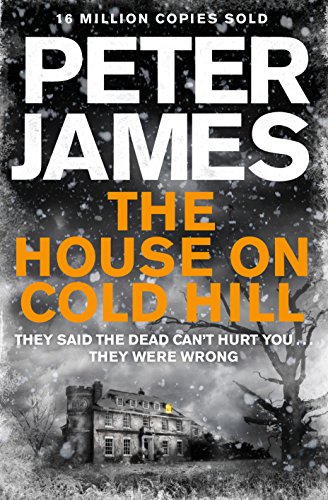

About Cold Hill
Peter James’s Cold Hill books form a two-novel supernatural horror sequence built around a haunted site in the Sussex countryside. The House on Cold Hill introduces the doomed Georgian mansion and the family unfortunate enough to move into it, while The Secret of Cold Hill shifts the action to the modern housing development later constructed on the same land. Although James’s official bibliography places the books among his standalones, the second is explicitly presented as the follow-up—and standalone sequel—to the first, making them a closely connected pair rather than unrelated ghost stories.
The House on Cold Hill, published in 2015, follows Ollie Harcourt, his wife Caro, and their twelve-year-old daughter Jade as they leave Brighton and Hove for an enormous, dilapidated country house. Ollie sees the move as an opportunity: Cold Hill House offers space for the family, room for his web-design business, and the possibility of restoring a valuable property. Caro is less enthusiastic, while Jade resents being separated from her friends. Their ordinary disagreements quickly become secondary when inexplicable things begin happening inside the house.
The haunting combines traditional ghost-story imagery with distinctly modern technology. A spectral woman appears during a FaceTime conversation, figures are seen staring from an upstairs window, and the Harcourts discover unsettling contradictions within the architecture itself, including indications of a room that should not exist. James uses those details to undermine Ollie’s attempts to find rational explanations for increasingly threatening events.
The fictional house also has an unusually personal origin. James has explained that Cold Hill House was inspired by a historic Sussex property that he and his former wife bought in 1989. He describes that real house as genuinely haunted and recalls experiences associated with several supposed ghosts. Rather than reproducing those events literally, he used the atmosphere and circumstances of living in the property as the foundation for his fictional haunted house.
The Secret of Cold Hill, published in 2019, does not simply place another family inside the same mansion. Cold Hill House has been destroyed by fire, and developers have replaced it with Cold Hill Park, a collection of expensive contemporary homes. Jason and Emily Danes are among the first residents, as are retired couple Maurice and Claudette Penze-Weedell. Their houses represent everything the old mansion was not: new construction, modern design, and the promise that whatever happened previously has disappeared with the ruins.
That assumption proves dangerously optimistic. Disturbances begin despite the absence of the original building, suggesting that the evil associated with Cold Hill belongs to the land and its history rather than simply to bricks and timber. The sequel therefore develops the first novel’s premise rather than repeating it. Demolishing a haunted house turns out to be very different from destroying whatever made it haunted.
Cold Hill stands apart from Peter James’s Roy Grace crime novels while drawing on another longstanding strand of his career: supernatural suspense. The two books are less concerned with investigating whether ghosts exist than with watching rational people exhaust every comforting explanation available to them. Their connecting idea is particularly effective because it removes the obvious solution to a haunted-house story. The mansion can be abandoned, burned, and replaced completely, yet Cold Hill itself remains—and whatever has claimed the place is not dependent on the house surviving.