
Below is the complete list of Lisa See’s Red Princess books in order. For this series, the chronological reading order is the same as the order of publication.
Publication Order of Red Princess Books


About Red Princess
Lisa See’s Red Princess Mysteries follow Liu Hulan, an investigator with China’s Ministry of Public Security, and American attorney David Stark through three interconnected crime novels set against the rapid economic and political changes transforming China in the late twentieth century. Beginning with Flower Net and continuing through The Interior and Dragon Bones, the series combines murder investigations with international politics, corporate interests, cultural conflict, archaeology, and the evolving relationship between its two protagonists.
Hulan is an unusual figure within See’s bibliography. Born into a privileged Chinese family with deep revolutionary connections, she is effectively a “Red Princess,” a term associated with descendants of important Communist Party figures. Her background gives her access and social standing, but it also carries painful history. During the Cultural Revolution, her family was torn apart, and she spent part of her youth in the United States before eventually returning to China and entering law enforcement.
David Stark represents the other side of the series’ Chinese-American perspective. An American lawyer with professional ties that repeatedly bring him into Chinese affairs, he also shares a complicated personal history with Hulan. Their relationship develops alongside the investigations rather than functioning as a separate romantic subplot, and by the final novel their private lives have become deeply entangled with the pressures created by their work.
Flower Net begins with two deaths that appear to connect powerful families on opposite sides of the Pacific. The son of the American ambassador is found dead in Beijing, while another victim, linked to China’s political elite, is discovered aboard a ship carrying undocumented Chinese migrants near California. Hulan and David are brought together as Chinese and American authorities attempt to understand how the cases intersect. The investigation moves between Beijing and Los Angeles and introduces the mixture of political influence, organized crime, business, and personal loyalty that characterizes the trilogy.
The Interior narrows its attention toward rural China and the consequences of the country’s accelerating economic transformation. Hulan investigates the suspicious death of a young woman employed at a toy factory, eventually going undercover among its workers. At the same time, David’s legal obligations connect him to business interests surrounding the same company. Their positions place them uncomfortably on different sides of an investigation involving working conditions, corruption, foreign investment, and murder.
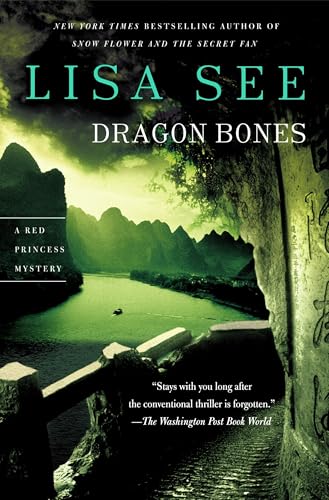
By Dragon Bones, Hulan and David are married but carrying substantial personal grief. The central investigation takes them to the Three Gorges Dam project, where the death of an American archaeologist becomes connected to archaeological theft, political sensitivity, and competing ideas about China’s ancient heritage and modern future. The enormous dam project provides See with a particularly effective setting because it embodies many of the tensions running through the entire trilogy: progress against preservation, government authority against individual interests, and history threatened by rapid modernization.
Although each novel contains a self-contained mystery, Hulan and David’s shared history makes the trilogy more cohesive when read as a sequence. Their circumstances change significantly between cases, and earlier experiences continue to affect their judgments and relationship.
The Red Princess books occupy a distinctive place in Lisa See’s career. Before the historical novels for which she later became especially famous, these mysteries already displayed her interest in China’s past and present, Chinese-American connections, family inheritance, and the ways political forces shape private lives. The suspense plots provide the framework, but Hulan’s divided cultural experience and the changing China around her give the trilogy its deeper continuity.