
Below is the complete list of Jennifer Haigh books in order. For each series, the chronological reading order is the same as the order of publication.
Publication Order of Bakerton Stories Books


Publication Order of Standalone Books




Publication Order of Short Stories/Novellas Books


Publication Order of Non-Fiction Books

Publication Order of Collections Books

Publication Order of Inheritance Collection Books



About Jennifer Haigh
Jennifer Haigh is an American novelist and short-story writer whose fiction examines families, communities, and institutions strained by secrecy, economic change, moral conflict, and unequal power. Born in 1968 and raised in Barnesboro, a former coal-mining town in western Pennsylvania, she grew up in a region whose industrial history would become central to several of her most accomplished books. She studied French at Dickinson College and later earned an MFA from the Iowa Writers’ Workshop.
Haigh made her literary debut with Mrs. Kimble in 2003. The novel follows three women who marry the same elusive man at different stages of his life, constructing his character through the damage, confusion, and competing memories he leaves behind. Its unusual structure established Haigh’s preference for multiple viewpoints and her interest in people who understand only part of the lives unfolding around them. The book won the PEN/Hemingway Award for debut fiction.
Her second novel, Baker Towers, introduced Bakerton, a fictional Pennsylvania mining town closely informed by the landscape and social history of her childhood. Following the Novak family through the years surrounding the Second World War, the novel portrays a community sustained by coal even as the industry’s decline begins to reshape its future. Bakerton later became the setting for the linked-story collection News from Heaven, which follows residents who stay, leave, return, or remain psychologically tied to the town long after moving elsewhere.
Haigh revisited Bakerton in Heat and Light, shifting the community into the era of hydraulic fracturing. The novel brings together landowners, energy workers, environmental researchers, families, and activists affected by a natural-gas boom. Rather than reducing the subject to a contest between industry and opposition, Haigh examines the economic desperation that makes extraction attractive, the risks distributed among residents, and the uncertainty surrounding promises of revival. These three Bakerton books are connected through place and recurring community history, though each retains its own principal characters and narrative.
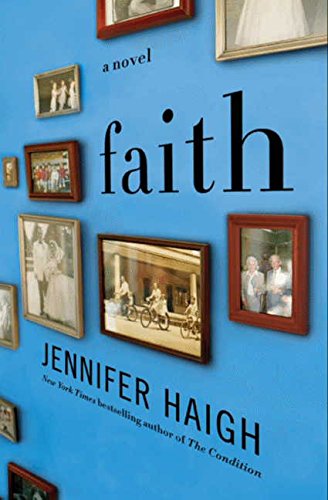
Her other novels are independent works. The Condition follows a New England family whose relationships are altered by a daughter’s medical diagnosis and by grievances accumulated over decades. Faith centers on an Irish American Catholic family after a priest is accused of abusing a child, exploring loyalty and doubt during the clerical abuse crisis. Haigh avoids building the novel around simple certainty, instead showing how memory, institutional allegiance, and private knowledge shape what family members are prepared to believe.
Mercy Street draws partly on Haigh’s experience working at a women’s health clinic. Set in Boston, it connects a clinic counselor with patients, protesters, and isolated men drawn into increasingly dangerous ideological spaces. The novel examines abortion, class, loneliness, online radicalization, and the personal realities often excluded from public arguments. It received the Mark Twain American Voice in Literature Award.
Her 2025 novel, Rabbit Moon, moves to Shanghai, where divorced parents reunite after their estranged daughter is critically injured in a hit-and-run accident. The crisis exposes hidden aspects of the young woman’s life and unresolved events within the family, while her adopted sister’s connection to China adds another layer to the novel’s treatment of identity and belonging.
Haigh writes in a clear, psychologically observant realist style, frequently allowing several characters to interpret the same event differently. Work, religion, illness, geography, and money are not secondary details in her fiction; they determine what choices people possess and who must absorb the consequences. Her bibliography is best understood as a collection of stand-alone family and social novels, with the Bakerton works forming a distinct, loosely connected body within it.