
Below is the complete list of Terry Pratchett’s Bromeliad Trilogy books in order. For this series, the chronological reading order is the same as the order of publication.
Publication Order of Bromeliad Trilogy Books

About Bromeliad Trilogy
Terry Pratchett’s Bromeliad Trilogy is a compact children’s fantasy sequence made up of Truckers, Diggers, and Wings. It is also commonly known as the Nome Trilogy, a useful alternative title because the books follow a small race of beings called nomes as they discover that the world is far larger, stranger, and more dangerous than they had ever imagined. Unlike Discworld, the trilogy is not a sprawling shared universe or a long comic saga. It is a tightly connected three-book story about migration, belief, survival, technology, and the shock of realizing that everything your community treats as eternal may simply be one small corner of reality.
Truckers begins with one of Pratchett’s sharpest children’s-fiction premises. A group of nomes lives inside a vast department store called Arnold Bros, where generations have grown up believing the Store is the whole world. Its departments function almost like countries or tribes, its signs read like scripture, and its routines create a complete civilization. Into this enclosed society comes Masklin, an Outside nome whose knowledge of the wider world challenges everything the Store nomes think they know. When they learn that the building is due to be demolished, the difference between belief and survival becomes urgent.
The first book is funny because the nomes misread human objects, language, and institutions, but the comedy carries a larger point. Pratchett is interested in how societies explain the unknown and how frightening it can be when the explanation stops working. The Store nomes are not foolish because they believe in the Store; they have built a worldview from the evidence available to them. Their bravery begins when they are forced to act before they fully understand.
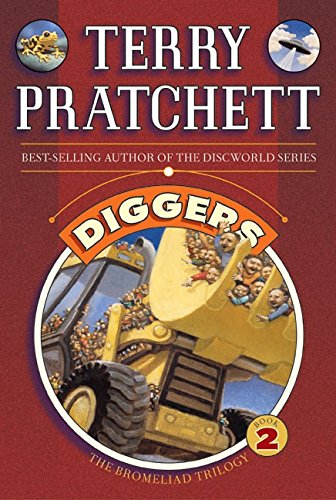
Diggers follows the nomes after their escape, as they try to build a new life in an abandoned quarry. The move outside does not solve their problems. Freedom brings weather, hunger, machinery, disagreement, and the need to make practical decisions without the old certainties of the Store. Grimma becomes especially important in this part of the trilogy. Intelligent, skeptical, and unwilling to accept limits placed on her by tradition, she gives the story a strong thread of social change. The nomes are not only learning about humans and machines; they are also learning that their own customs can be questioned.
Wings expands the scale again, sending the story toward airports, flight, and the possibility that the nomes’ true origins are even more astonishing than they suspected. The mysterious Thing, a small computer-like object carried by Masklin’s group, becomes central to the trilogy’s science-fiction dimension. What first appears to be a story about tiny people escaping a department store gradually becomes a tale of exile, lost history, and the search for home.
The title Bromeliad reflects the trilogy’s central metaphor: a complete little world existing inside something much larger. Pratchett uses that idea with great economy. The nomes’ world keeps expanding, but each expansion also requires them to abandon an older form of certainty. The Store, the quarry, the airport, the sky, and the idea of another home all become stages in a widening understanding of existence.
Although written for younger readers, the trilogy has much of Pratchett’s mature intelligence. It is playful, satirical, humane, and quietly philosophical. Its deepest subject is not smallness, but perspective: how people adapt when the universe turns out to be bigger than their maps, their myths, and their courage—at least until courage catches up.