
Below is the complete list of Alexander Chee books in order. For each series, the chronological reading order is the same as the order of publication.
Publication Order of Inheritance Collection Books




Publication Order of Standalone Books


Publication Order of Non-Fiction Books
About Alexander Chee
Alexander Chee is a Korean American novelist and essayist whose work moves between autobiographical fiction, historical spectacle, cultural criticism, and personal reflection. Born in Rhode Island in 1967, he spent parts of his childhood in South Korea, Guam, and Maine. Those experiences of movement, mixed heritage, and uncertain belonging became important to his writing, which frequently examines identity as something shaped by memory, performance, secrecy, and the expectations imposed by others.
Chee studied at Wesleyan University, where he took writing classes with Annie Dillard, whose demanding approach to sentences and literary craft remained influential throughout his career. He later earned an MFA from the Iowa Writers’ Workshop. Before establishing himself as a novelist, he held a variety of jobs—including bookselling, catering, gardening, and tarot reading—and participated in AIDS activism in New York. These experiences later supplied material for his essays, particularly his reflections on money, artistic ambition, political responsibility, and the practical struggle to build a writing life.
His debut novel, Edinburgh, was published in 2001. Set largely in Maine, it follows Fee, a Korean American boy whose musical talent earns him a place in a boys’ choir, where he and other children are sexually abused by their director. The novel is concerned less with the exposure of the crime than with its long psychological aftermath: shame, desire, dissociation, memory, and the ways trauma alters a person’s relationships with others and with himself. Chee drew upon autobiographical experience while deliberately using fiction to transform events rather than reproduce them as memoir.
Edinburgh won the Michener-Copernicus Prize, the Asian American Writers’ Workshop Literary Award, and the Lambda Literary Foundation’s Editor’s Choice Prize. Its lyrical intensity and fragmented movement through time established Chee as a writer willing to confront painful material without reducing it to testimony or a conventional recovery narrative.
Fifteen years passed before the publication of his second novel, The Queen of the Night. The book represents a dramatic change in scale and setting. Its protagonist, Lilliet Berne, is a celebrated soprano in nineteenth-century Paris whose secret past appears unexpectedly in the libretto of a new opera written for her. Her attempt to identify who knows her history unfolds through war, revolution, aristocratic society, circus performance, espionage, betrayal, and repeated reinvention.
Structured with the extravagance and reversals of grand opera, The Queen of the Night explores performance as both imprisonment and survival. Lilliet repeatedly assumes identities required by circumstance, but each transformation raises the question of whether freedom is possible when the world values the role more than the woman performing it. The novel’s historical detail, elaborate plotting, and theatrical atmosphere contrast with the compressed intimacy of Edinburgh, while retaining Chee’s interest in secrecy, damaged memory, and identities created under pressure.
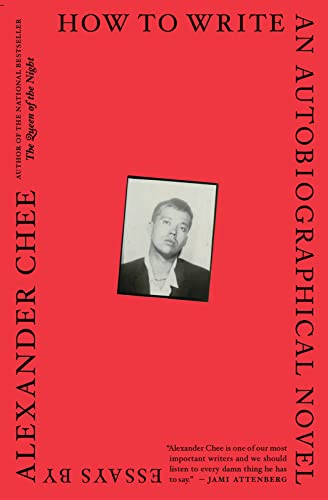
Chee brought those concerns into nonfiction with How to Write an Autobiographical Novel, a collection of essays published in 2018. The book addresses his father’s death, childhood trauma, Korean American and queer identity, the AIDS crisis, political activism, teaching, gardening, and the long process of becoming a writer. Despite its title, it is not a conventional writing manual. It examines how lived experience becomes art and what ethical, emotional, and political responsibilities accompany that transformation.
His essays and fiction are united by an exacting, image-rich style and a fascination with the boundary between concealment and revelation. Chee has received a Whiting Award, a National Endowment for the Arts fellowship, and a Guggenheim Fellowship. He has taught at several institutions and is a professor of English and creative writing at Dartmouth College. His bibliography is small in number but unusually varied, comprising two markedly different novels and an essay collection that clarifies the personal and artistic questions running through both.